
From our kitchen — a XingAI Cook guide
Korean Ramen — The Full Roster & Beginner's Guide
Start with a scene from our house. Coming home after a long stretch of travel, nobody here wants a feast of meat and fish. What we want is the bowl of Shin Ramyun Mom cooks, with two fried eggs on top. The hot soup comes to the table, and she watches you eat — that is what home tastes like. She is Korean, and ramen is the bowl she makes best. This page starts from that bowl and introduces Korean ramen properly: where it came from, the families it comes in, the five big houses and their personalities, and the picks she chose herself. No recipes, no nutrition lectures — just a bowl of noodles, and the people who eat it. And because one shopping trip filled our table with more kinds than we could count on two hands, this page now also keeps the full roster: every pack on our table in one table — the ones with a verified figure ranked by that figure, whether it was read off the label on our own pack or matched to the maker's published number for the exact version we own, and every figure marked with exactly where it came from.
The video for this recipe is coming soon.
Ingredients
- Shin Ramyun (Nongshim) — the classic spicy soup, the standard since 1986
- Shin Black (Nongshim) — the richer beef-bone big brother
- Neoguri (Nongshim) — thick noodles in a spicy seafood broth
- Chapagetti (Nongshim) — black-bean noodles, no soup, all comfort
- Buldak (Samyang) — the fire-chicken stir noodles the internet fell for
- Jin Ramen Mild & Hot (Ottogi) — the gentle everyday bowl and its spicy twin
- Bibim Men (Paldo) — sweet-spicy noodles, served cold
- Naengmyeon kits — Korea's cold noodles, a summer tradition
The map — four families of Korean ramen
- Soup ramen, the heart of it — A hot, red, honest broth: Shin Ramyun is the standard, Ansungtangmyun the older, earthier traditional soup, and Jin Ramen the milder everyday bowl. When someone says 'ramen' in Korea, this is the bowl they picture.
- Stirred and saucy, no soup — The noodles are drained and folded through a thick sauce instead: Chapagetti's black-bean richness, Bibim Men eaten cold and sweet-spicy, and Buldak, the fire-chicken stir noodle that turned into a worldwide challenge.
- Seafood bowls — Neoguri leads here: extra-thick noodles in a spicy seafood broth, with a piece of kelp riding in the packet like a little flag.
- Cold noodles are their own country — Naengmyeon, icy buckwheat noodles in chilled broth or spicy sauce, is a traditional dish, not an instant ramen; but Korean grocery stores sell ready kits right beside the ramen shelf, and no map of Korean noodles is complete without it. And beside everything, the cup: the same classics in cup form, ready wherever hot water is.
An honest note from our table: everything on this page is a common, widely sold classic — the kind you will find in any Korean grocery or H Mart. No limited editions, no store gossip, and no prices or stock claims, because shelves change and the classics do not. Instant ramen is an occasional joy in our house, not an everyday food: one bowl, something fresh on top, eaten slowly.
How a packet became a country's comfort
Instant ramen came to Korea in 1963, when Samyang made the country's first packet — a practical answer to hungry years, built from wheat when rice was short. It was adopted slowly, and then completely. In 1986 Nongshim launched Shin Ramyun, spicy and beefy and unapologetic, and it became the bowl Korea measures all others by. Koreans still eat more instant noodles than almost anyone on earth — about 79 packets a year each, second only to Vietnam (World Instant Noodles Association, 2024). And the packet keeps travelling: Samyang's Buldak arrived in 2012, a 'fire noodle challenge' video sent it around the world in 2014, and Korean ramen exports have set record after record since, passing a billion dollars in 2024 (Korea Customs Service). Sixty years on, the humble packet is comfort at home and an ambassador abroad.
Five houses, five personalities
Nongshim — the house of the classics: Shin Ramyun, Neoguri, Chapagetti. The shelf you start from.
Samyang — the original, from 1963, reborn as the firebrand: Buldak is its world-famous second act.
Ottogi — the gentle everyday house: Jin Ramen in mild and hot, sesame ramen — bowls nobody has to brace for.
Paldo — the cold-noodle house: Bibim Men defined sweet-spicy cold noodles, and its Gomtang is a calm beef-bone soup.
Pulmuone — the lighter touch: known for non-fried, air-dried noodles and a fresher feel.
The Korean Wife's Ramen Picks — Series 1 · For the kids
Mom — the Korean wife in this house, and the best ramen cook we know — keeps it simple for the kids: no heat, all comfort. Jin Ramen Mild, the gentle one. Soon Veggie, Nongshim's mild vegetable bowl. And Paldo's Gomtang, a soft beef-bone soup that tastes like being looked after. Her rule is the one from her own table: a child should finish a bowl smiling, not sweating.
The Korean Wife's Ramen Picks — Series 2 · For the grown-ups
For the grown-ups, she lets the soup speak up. Shin Ramyun — the standard, and the very bowl she cooks at home, with two fried eggs on top. Shin Black when the day calls for something deeper and richer. And Buldak for the brave: the original is already a fire drill, the 2x is a dare, and the Carbonara is how she talks spice-shy friends into trying — creamy first, heat second.
The Korean Wife's Ramen Picks — Series 3 · For the grandparents
For the grandparents, she goes soft and light. The non-fried bowls first — Shin Ramyun Light and Pulmuone's air-dried noodles — which she finds gentler, while still being a proper bowl of soup. And Ansungtangmyun, Nongshim's traditional soup from 1983, earthy and unhurried: the taste of the old days, in the good way.
Little habits at a Korean table
A few things you will see wherever Koreans eat ramen. An egg goes in — cracked straight into the broth, or fried and laid on top, like our two fried eggs. A slice of cheese melts over the spicy bowls and softens the fire. When ramen meets tteokbokki you get rabokki, chewy rice cakes in the same red sauce. The pot lid becomes a plate: hot noodles lifted onto the cool metal lid, one bite at a time. Army stew (budae jjigae) is not finished until a block of ramen goes in. And convenience stores are ramen kitchens of their own, with hot water and a seat by the window — some of the most contented meals in Korea happen there, one cup at a time.
Questions, answered
What is Korean ramen? Instant noodles made the Korean way — most often a hot, spicy soup with chewy noodles, though the family also includes saucy stir noodles and cold noodles. In Korean it is called ramyeon.
Which Korean ramen is not spicy? Jin Ramen Mild, Soon Veggie and Gomtang are the gentle classics, and the non-fried lines (Shin Ramyun Light, Pulmuone) feel lighter too. Start there — that is what Mom picks for kids and grandparents.
How spicy is Buldak, really? The original is properly hot, a wide margin above Shin Ramyun, and the 2x is roughly double that again. The Carbonara is the mildest door into the family: creamy, with the heat turned down to a glow.
Is naengmyeon a kind of ramen? Not exactly. Naengmyeon (cold noodles) is a traditional Korean noodle dish, older than instant ramen; stores sell ready kits near the ramen shelf, but it belongs to its own family.
Where can I buy these? Any Korean grocery store, or the Korean aisle of an H Mart — these are the common, always-around classics, not limited editions. And in our house, the Shin Ramyun with two fried eggs lives over on our Homemade Noodles series page.
The Great Ramen Battle — the lineup is ready, the first bowls land next week
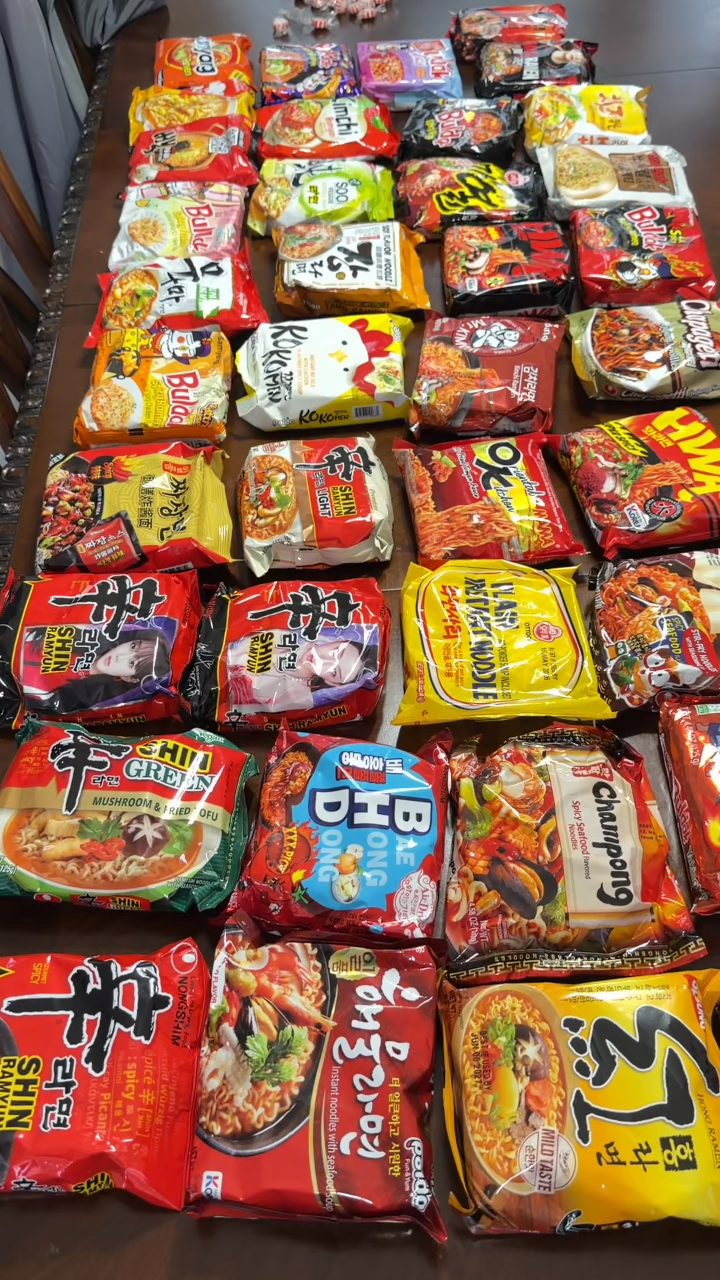
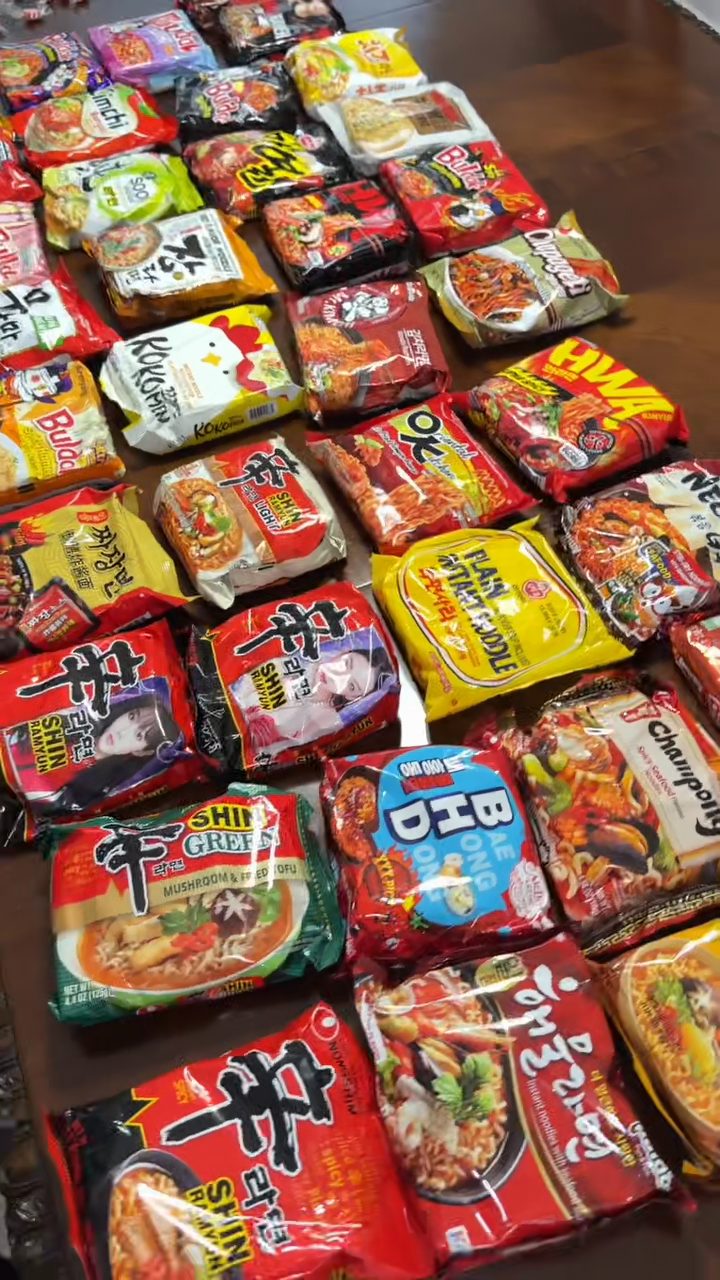
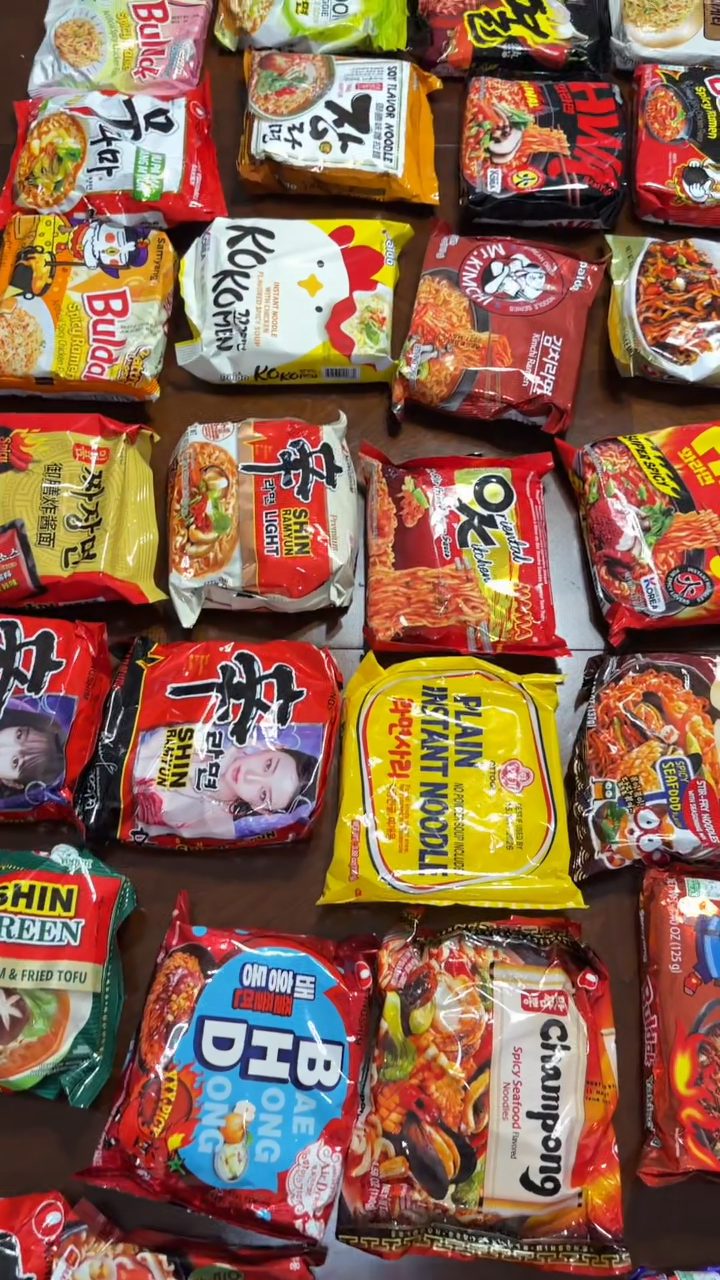
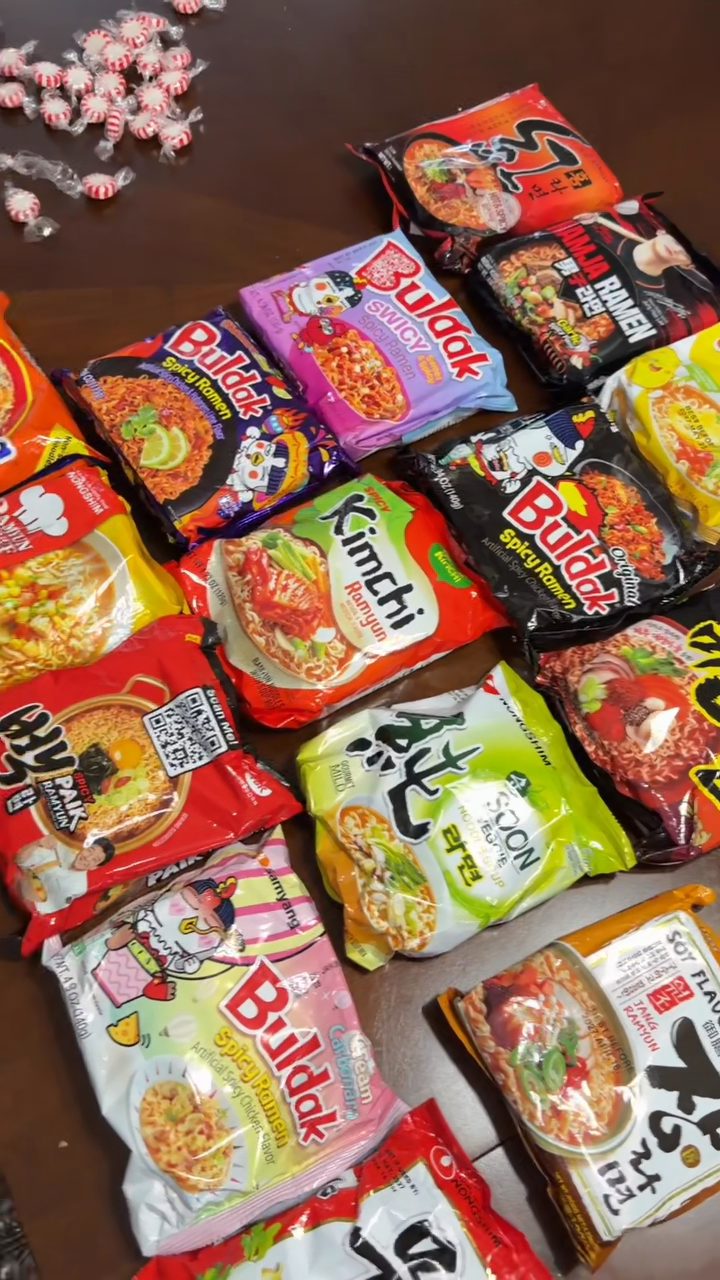
It started, the way these things do, with grocery bags. One shopping trip turned into bags of ramen on the table, then a pantry shelf stacked with reserves, and finally the whole collection spread across the table in formation — about 35 kinds, counted one by one on camera. That table is now a starting grid.
Next week the cooking starts. The format: every kind gets a number and a duel — cooked for real, eaten for real, one honest verdict each, and no ties handed out for politeness. The scoreboard is public and the rules are fixed in advance: views and likes lead, the like-to-view ratio breaks close calls, and the final No. 1 is decided by a community vote once every contender has had its two weeks in the ring.
While the kitchen warms up, two warm-up games — play them in the comments of the teaser video. Game one, spot the guest: one of the 35 is not Korean at all; it slipped into the lineup from another country. Which one? Game two, spot the twin: exactly one kind was bought in exactly two packs — every other kind is a single. Find it in the formation. The answers are not on this page; they live in the comments, and we will pin the first correct answers when the battle opens.
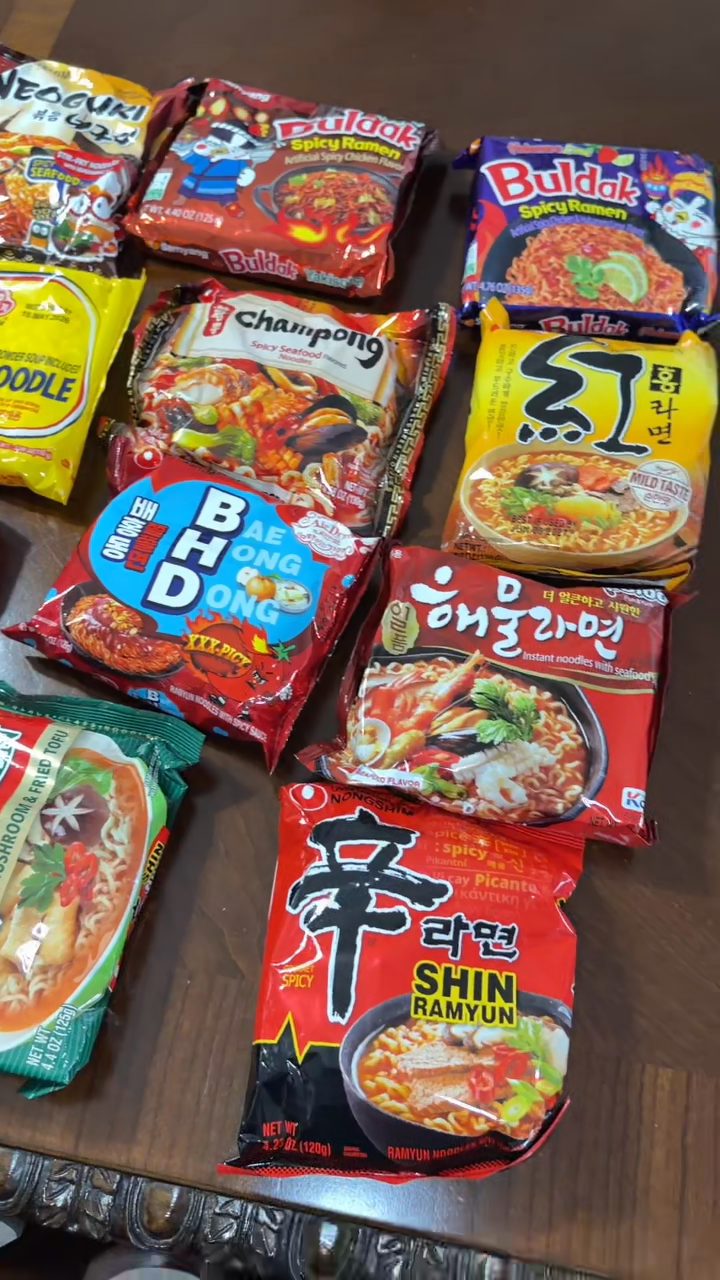
Calorie King — the first scoreboard is on the wall
Before the first bowl is cooked, the battle has its first event: the Calorie King — and the scoreboard now runs on two tracks. The house rule never changed: every number is per pack, the whole pack, and where a label counts two servings in one pack, we do the maths the label itself sets out and show the working. What changed is where a number may come from. Track one is the labels on our own packs, read off the real thing. Track two is the maker's own published figure, confirmed against a second source and admitted only when it matches the exact version sitting on our table — the version rides beside each figure. In the roster table below, the badge on every row says which track it came in on.
Read off our own packs:
1. Neoguri Stir-Fry Seafood (Nongshim) — 620 kcal per pack
2. Buldak Cheese, orange export pack (Samyang) — 590 kcal per pack
3. Champong (Nongshim) — 560 kcal per pack (280 × 2 servings)
4. Buldak 2X Spicy (Samyang) — 550 kcal per pack
5. Kokomen (Paldo) — 520 kcal per pack
6. Buldak Cheese 'Last Flame', red pack (Samyang) — 510 kcal per pack
7. Mupama Tangmyun (Nongshim) — 500 kcal per pack (250 × 2 servings)
8. Hong Ramyun (Paldo) — 490 kcal per pack
9. Jang Ramyun, Soy Flavor — 490 kcal per pack
10. Namja Ramen, Garlic Spicy (Paldo) — 490 kcal per pack (115 g pack)
11. Ottogi Cheese Ramyun — 470 kcal per pack
12. Ottogi Plain Instant Noodle (Ottogi) — 470 kcal per pack (110 g pack)
In on official figures, double-checked — version noted:
13. Buldak Quattro Cheese (Samyang) — 590 kcal per pack (145 g pack)
14. Buldak Carbonara (Samyang) — 550 kcal per pack (130 g pack)
15. Buldak Cream Carbonara (Samyang) — 550 kcal per pack (140 g pack)
16. Shin Green (Nongshim) — 540 kcal per pack
17. Buldak Yakisoba (Samyang) — 530 kcal per pack (130 g pack)
18. Buldak Habanero Lime (Samyang) — 530 kcal per pack (135 g pack)
19. Shin Ramyun (Nongshim) — 520 kcal per pack (U.S. version: 260 × 2 servings)
20. Neoguri, soup version (Nongshim) — 510 kcal per pack
21. Jin Ramen (Ottogi) — 500 kcal per pack (120 g pack)
22. Paldo Ilpoom Seafood — 495 kcal per pack (⚠ the 120 g version only — the 115 g version reads 475, and our pack's weight is still to be re-checked)
23. Mr. Kimchi (Paldo) — 490 kcal per pack (⚠ the 115 g bag, soup version only)
24. Soon Veggie (Nongshim) — 480 kcal per pack (240 × 2 servings)
25. Gompaghetti (Paldo) — 460 kcal per pack (⚠ the 110 g dry version only)
26. Shin Light (Nongshim) — 340 kcal per pack (⚠ the current U.S. 97 g label only)
Still off the board — names only, until their own labels read clearly or an official figure matches the exact pack we own: Kimchi Ramyun, HWA Ramyun, Chapagetti, Bae Hong Dong, Paldo Ilpoom Jjajang, OK Ramyun, Ottogi Sesame, Samyang Original, Ramyun Chef Curry Chicken, Buldak Original, Buldak Swicy, MAMA Oriental Kitchen, Paik Ramyun and Ottogi Maneung (garlic).
A scoreboard, not a sermon: read it the way you would read a racing form. And until every contender is on the board, the crown is provisional.
The roster — every pack on our table, in one table
This is the whole collection as it stands. The packs with a verified number sit at the top, ranked by calories per pack; the rest wait below, in the order we will weigh them in. Filter by house to walk one shelf at a time, sort the table however you like, and follow any pack's name to land on its own row — every row carries an anchor, so a single pack can be linked and cited on its own. The badge in the source column says exactly where each number came from, and an empty calorie cell is not a missing number: it is a number we have not been able to read honestly yet. Front and back photos of each pack join its row as the packs are opened and photographed flat.
| # | Pack | House | Form | Heat | kcal per pack | Source | Pack photos |
|---|---|---|---|---|---|---|---|
| 1 | Neoguri Stir-Fry Seafood | Nongshim | Stir / dry | Hot | 620 | Read off our own pack | 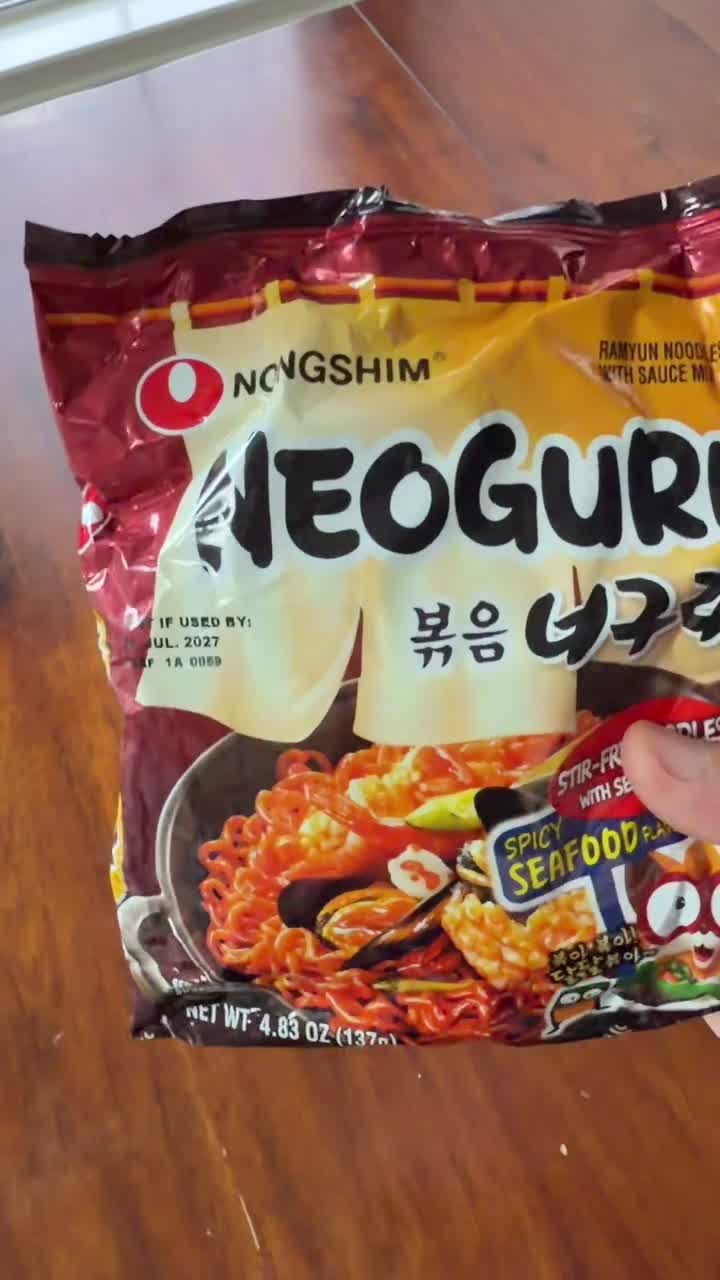 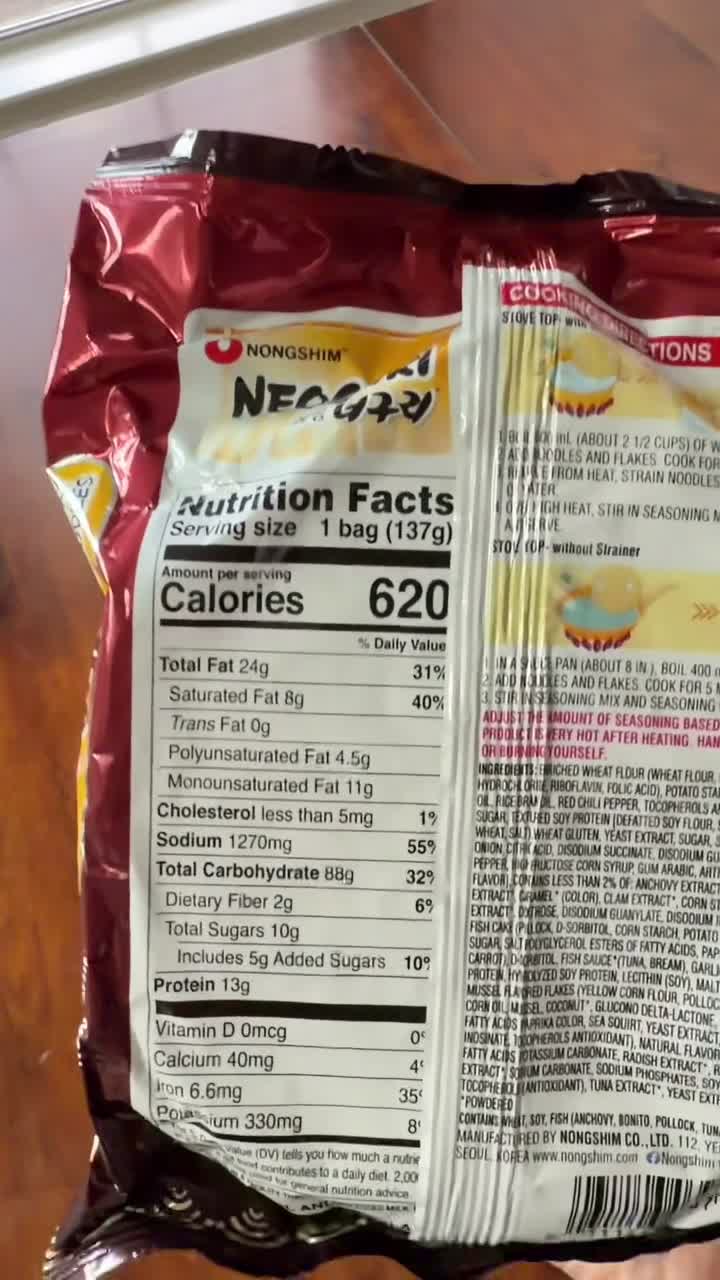 |
On the pack Stir / dry — the noodles boil on their own, get drained, then meet the sauce.5 min · per the pack's own directions, read off our pack Our way Cooked at our table on Nov 2, 2026 — station No. 2 of the Ramen Battle. Our way: the noodles into boiling water for 3 minutes, lid off and loosened, 1 more minute; the flakes and the whole seasoning pack in from the start, the oil pack thrown away (the cook of the house does not like that oil), plus Spam, green onion and white onion. The verdict: the seafood flavor is the strong one here — deep, and it fills the bowl; the seasoning looks brick-red but the heat is mild, not spicy at all; this bowl is carried by the sea, not by fire. Label facts read off our own pack, on camera: 137 g, 620 kcal, sodium 1,270 mg, protein 13 g. Read the full step-by-step guide → | |||||||
| 2 | Buldak Cheese — orange export pack | Samyang | Stir / dry | Gentle | 590 | Read off our own pack | Frontphoto to come Backphoto to come |
On the pack Stir / dry — the noodles boil on their own, get drained, then meet the sauce. Our way Not cooked yet — our way with this pack, and the tasting note, land here the day it meets our pot. | |||||||
| 3 | Champong | Nongshim | Soup | Hot | 560(280 × 2 servings) | Read off our own pack | Frontphoto to come Backphoto to come |
On the pack Soup bowl — the seasoning goes straight into the pot with the noodles. Our way Not cooked yet — our way with this pack, and the tasting note, land here the day it meets our pot. | |||||||
| 4 | Buldak 2X Spicy | Samyang | Stir / dry | Fire | 550 | Read off our own pack | Frontphoto to come Backphoto to come |
On the pack Stir / dry — the noodles boil on their own, get drained, then meet the sauce. Our way Not cooked yet — our way with this pack, and the tasting note, land here the day it meets our pot. | |||||||
| 5 | Kokomen | Paldo | Soup | Gentle | 520 | Read off our own pack | Frontphoto to come Backphoto to come |
On the pack Soup bowl — the seasoning goes straight into the pot with the noodles. Our way Not cooked yet — our way with this pack, and the tasting note, land here the day it meets our pot. | |||||||
| 6 | Buldak Cheese 'Last Flame' — red pack | Samyang | Stir / dry | Gentle | 510 | Read off our own pack | Frontphoto to come Backphoto to come |
On the pack Stir / dry — the noodles boil on their own, get drained, then meet the sauce. Our way Not cooked yet — our way with this pack, and the tasting note, land here the day it meets our pot. | |||||||
| 7 | Mupama Tangmyun | Nongshim | Soup | Gentle | 500(250 × 2 servings) | Read off our own pack | Frontphoto to come Backphoto to come |
On the pack Soup bowl — the seasoning goes straight into the pot with the noodles.7 min · per the pack's own directions, read off our pack Our way Not cooked yet — our way with this pack, and the tasting note, land here the day it meets our pot. | |||||||
| 8 | Hong Ramyun | Paldo | Soup | Gentle | 490 | Read off our own pack | Frontphoto to come Backphoto to come |
On the pack Soup bowl — the seasoning goes straight into the pot with the noodles. Our way Not cooked yet — our way with this pack, and the tasting note, land here the day it meets our pot. | |||||||
| 9 | Jang Ramyun, Soy Flavor▶ Watch the episode — EP13 — The Everyday Pack, Done Right 🍜 Paldo Jang Ramyun 8.2/10 — The Great Ramen Battle▶ Watch the full bowl — Paldo Jang Ramyun, Galbi on Top 🍜 The Everyday Pack, Done His Way — EP13 Long Cut (8.2/10) | Paldo | Soup | Gentle | 490(Read off our own pack's back label, on camera — 1 pack (120 g): 490 kcal for the whole pack; sodium 2,170 mg.) | Read off our own pack | Frontphoto to come Backphoto to come |
On the pack Soup bowl — the seasoning goes straight into the pot with the noodles. Our way Battle station No. 13 — the everyday pack, done his way. Greens into the warming water and out at the first boil; the cake two minutes, loosened strand by strand; the seasoning in after — but not all of it: this packet runs salty (the back label reads 2,170 mg of sodium), so hold some back, or use it all with more water. One egg cracked straight in, then heat off and a rest under the lid. Two slices of galbi from this morning's batch on top — a house topping, not part of the score — and raw garlic alongside, always. His verdict for the pack itself: 8.2 out of 10 — honest, everyday, worth buying again. Read the full step-by-step guide → | |||||||
| 10 | Ottogi Cheese Ramyun | Ottogi | Soup | No heat | 470 | Read off our own pack | Frontphoto to come Backphoto to come |
On the pack Soup bowl — the seasoning goes straight into the pot with the noodles. Our way Not cooked yet — our way with this pack, and the tasting note, land here the day it meets our pot. | |||||||
| 11 | Buldak Quattro Cheese | Samyang | Stir / dry | Gentle | 590(145 g pack — U.S. label figures agree at iHerb and Target) | Official, double-checked | Frontphoto to come Backphoto to come |
On the pack Stir / dry — the noodles boil on their own, get drained, then meet the sauce. Our way Not cooked yet — our way with this pack, and the tasting note, land here the day it meets our pot. | |||||||
| 12 | Buldak Carbonara | Samyang | Stir / dry | Gentle | 550(130 g pack — maker's official page (buldak.com) and iHerb) | Official, double-checked | Frontphoto to come Backphoto to come |
On the pack Stir / dry — the noodles boil on their own, get drained, then meet the sauce. Our way Not cooked yet — our way with this pack, and the tasting note, land here the day it meets our pot. | |||||||
| 13 | Buldak Cream Carbonara | Samyang | Stir / dry | Gentle | 550(140 g pack — iHerb and import-label figures agree) | Official, double-checked | Frontphoto to come Backphoto to come |
On the pack Stir / dry — the noodles boil on their own, get drained, then meet the sauce. Our way Not cooked yet — our way with this pack, and the tasting note, land here the day it meets our pot. | |||||||
| 14 | Shin Green | Nongshim | Soup | Gentle | 540(Label prints 540 per bag (not a servings doubling) — Nongshim USA and Directions for Me) | Official, double-checked | 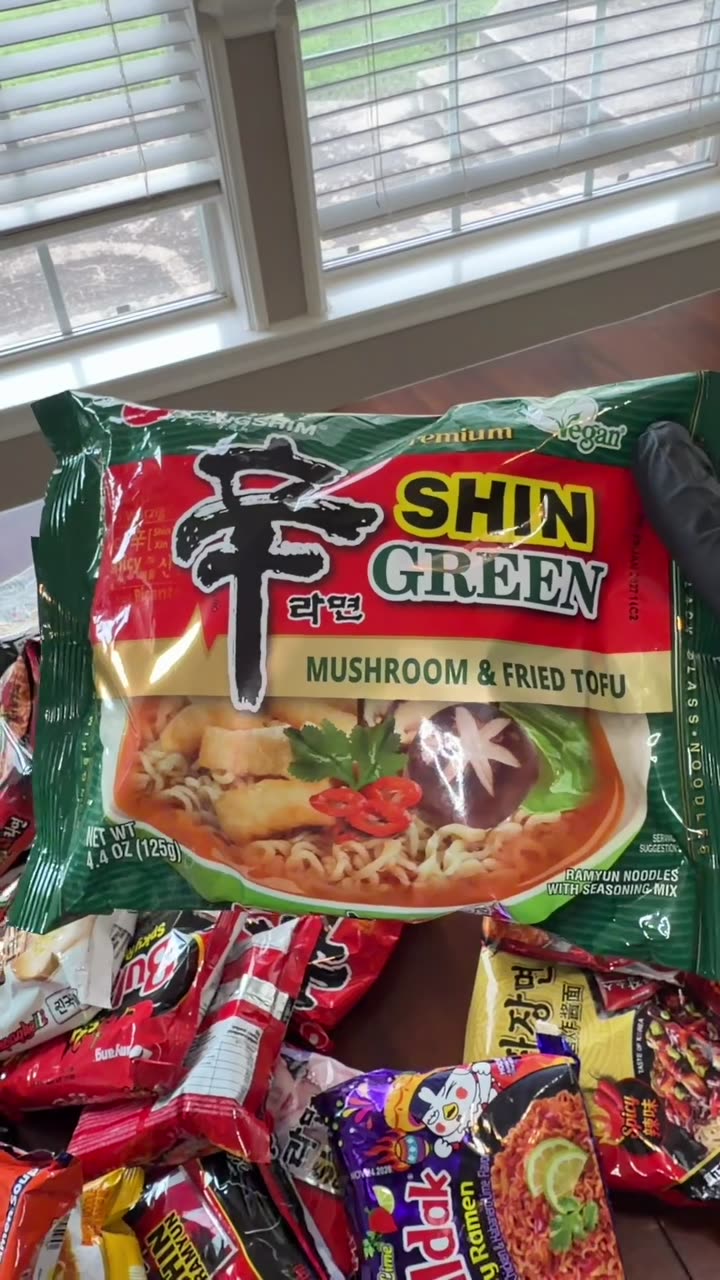 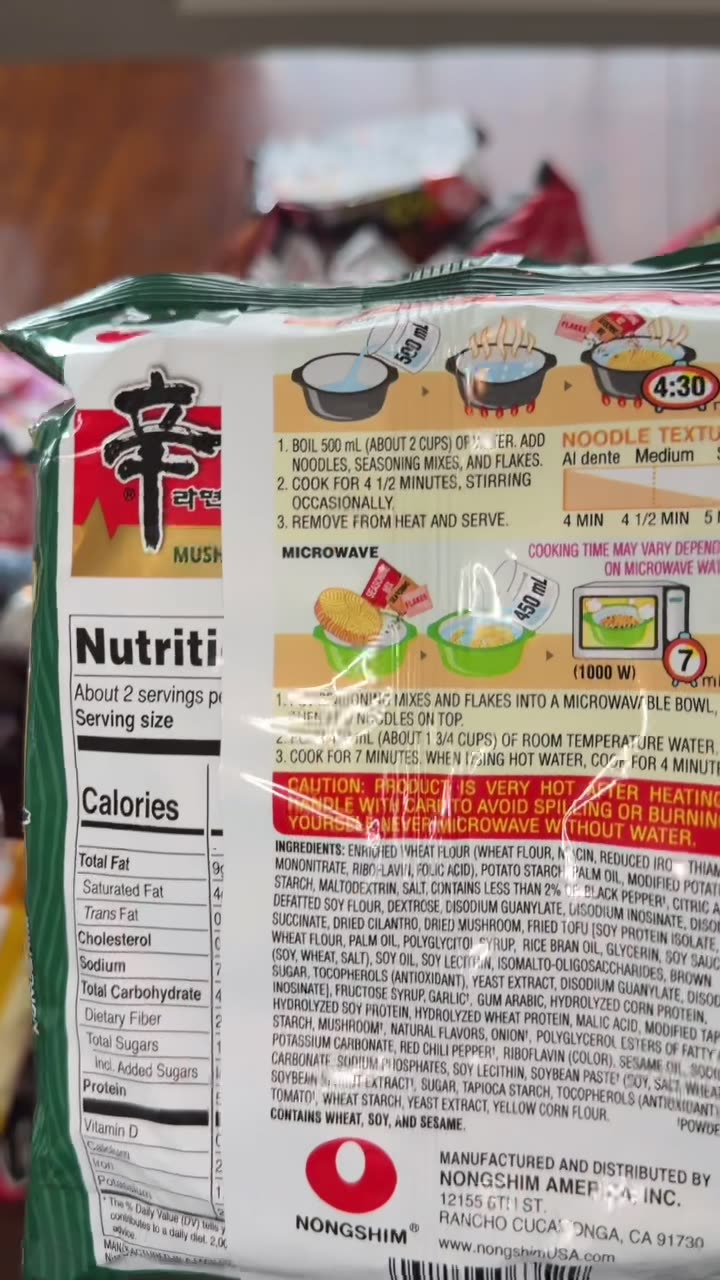 |
On the pack Soup bowl — the seasoning goes straight into the pot with the noodles.4.5 min · per the pack's own directions, read off our pack Our way Cooked at our table on Nov 2, 2026 — station No. 1 of the Ramen Battle. Our way: tomatoes and vegetables into the boiling water first, then the noodle block, the whole seasoning pack, and a few drops of lemon juice to finish; the whole pot into one big bowl — and timed at our stove, the noodles themselves cooked about 3½ minutes, a minute under the pack's printed 4½. The verdict: properly springy noodles, and a seasoning that is not spicy at all — the whole pack went in and it still wasn't hot, and not too salty either (the lemon may have seen to that). A gentle bowl just about anyone can eat. Read the full step-by-step guide → | |||||||
| 15 | Buldak Yakisoba | Samyang | Stir / dry | Gentle | 530(130 g pack — label transcriptions at Hungry Ninja and Open Food Facts) | Official, double-checked | Frontphoto to come Backphoto to come |
On the pack Stir / dry — the noodles boil on their own, get drained, then meet the sauce. Our way Not cooked yet — our way with this pack, and the tasting note, land here the day it meets our pot. | |||||||
| 16 | Buldak Habanero Lime | Samyang | Stir / dry | Fire | 530(135 g pack — maker's official page (buldak.com) and iHerb; matches the front of our pack) | Official, double-checked | Frontphoto to come Backphoto to come |
On the pack Stir / dry — the noodles boil on their own, get drained, then meet the sauce. Our way Not cooked yet — our way with this pack, and the tasting note, land here the day it meets our pot. | |||||||
| 17 | Shin Ramyun▶ Watch the episode — EP6 — Shin Ramyun × Silken Tofu, His Signature Way 🍜 The Great Ramen Battle▶ Watch the full bowl — How to Make Shin Ramyun × Silken Tofu, His Signature Way 🍜 EP6 — The Great Ramen Battle | Nongshim | Soup | Hot | 520(U.S. version: 260 × 2 servings — the Korean-market label (500) is a different version and is not used) | Official, double-checked | Frontphoto to come Backphoto to come |
On the pack Soup bowl — the seasoning goes straight into the pot with the noodles. Our way Not cooked yet — our way with this pack, and the tasting note, land here the day it meets our pot. | |||||||
| 18 | Neoguri (soup version) | Nongshim | Soup | Hot | 510(Label prints 510 per bag — Nongshim USA and Target) | Official, double-checked | Frontphoto to come Backphoto to come |
On the pack Soup bowl — the seasoning goes straight into the pot with the noodles. Our way Not cooked yet — our way with this pack, and the tasting note, land here the day it meets our pot. | |||||||
| 19 | Jin Ramen | Ottogi | Soup | Gentle | 500(120 g pack — current Spicy and Mild labels both print 500 (Weee! and Enuri)) | Official, double-checked | Frontphoto to come Backphoto to come |
On the pack Soup bowl — the seasoning goes straight into the pot with the noodles. Our way Not cooked yet — our way with this pack, and the tasting note, land here the day it meets our pot. | |||||||
| 20 | Paldo Ilpoom Seafood | Paldo | Soup | Hot | 495(⚠ 120 g version only — the 115 g version reads 475; our pack's weight is still to be re-checked (Dongwon Mall and Yami/Weee!)) | Official, double-checked | Frontphoto to come Backphoto to come |
On the pack Soup bowl — the seasoning goes straight into the pot with the noodles. Our way Not cooked yet — our way with this pack, and the tasting note, land here the day it meets our pot. | |||||||
| 21 | Mr. Kimchi | Paldo | Soup | Hot | 490(⚠ 115 g bag, soup version only — five nutrition databases converge on the same macros) | Official, double-checked | Frontphoto to come Backphoto to come |
On the pack Soup bowl — the seasoning goes straight into the pot with the noodles. Our way Not cooked yet — our way with this pack, and the tasting note, land here the day it meets our pot. | |||||||
| 22 | Soon Veggie▶ Watch the episode — EP12 — The Vegan Pack, a Steak on Top 🍜 Soon Veggie 8.0/10 — The Great Ramen Battle▶ Watch the full bowl — Soon Veggie Ramen, a Steak on Top 🍜 The Vegan Pack That Didn't Stay Vegan — EP12 Long Cut (8.0/10) | Nongshim | Soup | No heat | 480(240 × 2 servings — Nongshim USA and Directions for Me) | Official, double-checked | Frontphoto to come Backphoto to come |
On the pack Soup bowl — the seasoning goes straight into the pot with the noodles. Our way Battle station No. 12 — the vegan pack that didn't stay vegan. The mild Soon Veggie cake cooks in yesterday's beef bone broth cut with about half water, so the base stays light and never greasy; the cake goes in at a rolling boil, one stir after two minutes, then the heat goes off and the steam finishes it. On top, a small steak: seared hard in butter, sliced, rolled in his secret spice coat — cumin, two chili powders, garlic powder, a little MSG, a little salt. Raw garlic beside the bowl, always. His verdict for the noodle alone — the steak doesn't count: 8.0 out of 10. Chewy and honestly made, a step behind Chapagetti and Buldak. Read the full step-by-step guide → | |||||||
| 23 | Gompaghetti (gomtang-style, dry)▶ Watch the episode — EP5 — Gompaghetti, His Everyday Bowl 🍜 The Great Ramen Battle | Paldo | Stir / dry | No heat | 460(⚠ 110 g dry (stir) version only — the Premium Gomtang soup version carries a different figure) | Official, double-checked | Frontphoto to come Backphoto to come |
On the pack Stir / dry — the noodles boil on their own, get drained, then meet the sauce. Our way Not cooked yet — our way with this pack, and the tasting note, land here the day it meets our pot. | |||||||
| 24 | Shin Light | Nongshim | Soup | Gentle | 340(⚠ Current U.S. 97 g label only (Nongshim USA and Hungry Ninja) — a 363 kcal variant label also circulates; the two are told apart by fat on the back label (2.5 g vs 3.4 g)) | Official, double-checked | Frontphoto to come Backphoto to come |
On the pack Soup bowl — the seasoning goes straight into the pot with the noodles. Our way Not cooked yet — our way with this pack, and the tasting note, land here the day it meets our pot. | |||||||
| 25 | Kimchi Ramyun | Nongshim | Soup | Hot | — | Not yet read | Frontphoto to come Backphoto to come |
On the pack Soup bowl — the seasoning goes straight into the pot with the noodles. Our way Not cooked yet — our way with this pack, and the tasting note, land here the day it meets our pot. | |||||||
| 26 | Namja Ramen, Garlic Spicy | Paldo | Soup | Hot | 490(Per the 115 g pack in hand on cooking day, U.S. back label read on camera: 490 kcal, sodium 1,760 mg, total fat 18 g (saturated 8 g), carbs 74 g, fiber 3 g, sugars 15 g (added 1 g), protein 9 g, cholesterol 0 mg. Printed method on the same pack: 500 mL boiling water, noodles and packets in, 3 min 30 sec. This is the U.S. export label; other markets' labels for this name are not this row's figures.) | Read off our own pack | 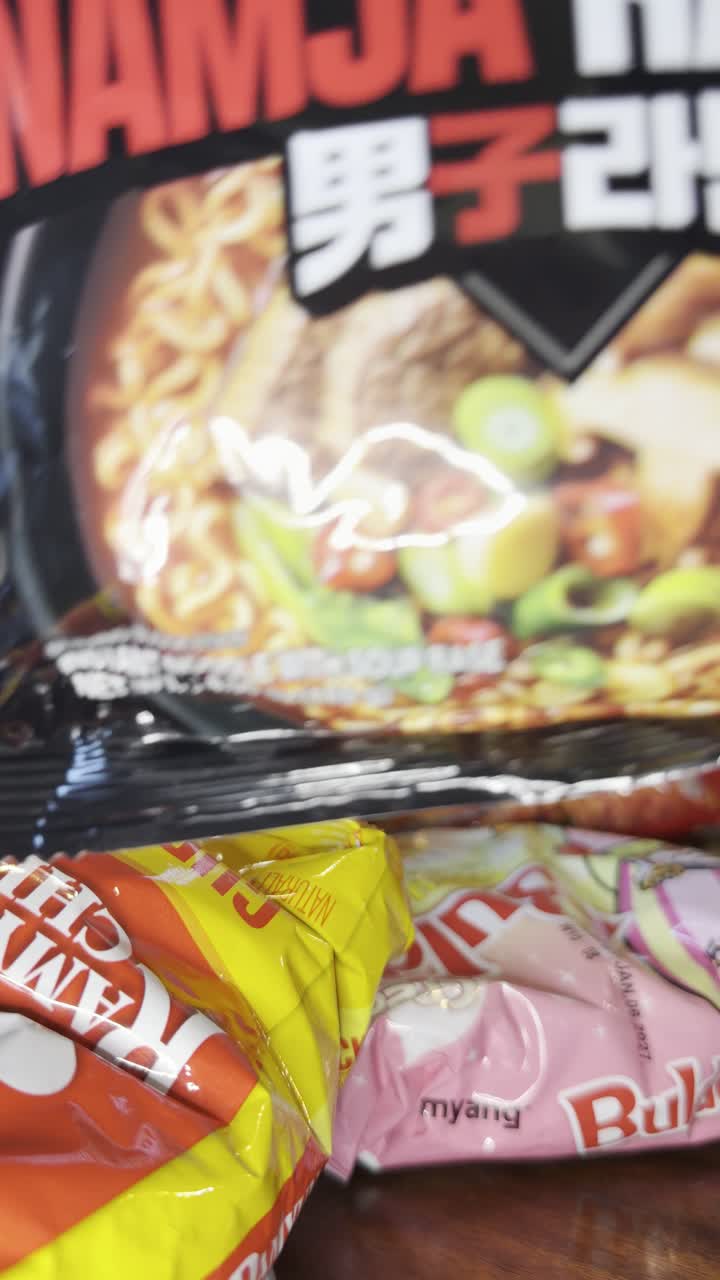 Backphoto to come |
On the pack Soup bowl — the seasoning goes straight into the pot with the noodles.3.5 min · per the pack's own directions, read off our pack Our way Cooked at our table on Nov 5, 2026 — station No. 4 of the Ramen Battle, and the cook's own favorite of the whole roster. On the pack: 500 mL of boiling water, noodles and packets in, 3 minutes 30 seconds, stir and eat. Our way is his way, the lunch he makes himself: the cake out over the bowl, packets waiting on top; water on with the lid on; a board of bok choy, eggs and green onion ready while it heats; the cake in at a rolling boil, greens in after; the lid lifted about once a minute to check — the look is his timer; the soup base late; two eggs cracked into the pot; the whole pot poured into the bowl; his daily vegetable salad beside it. Under ten minutes from prep to eating. The verdict, in the cook's own words: this is his favorite ramen — the flavor light and clean, the noodles especially chewy. Read the full step-by-step guide → | |||||||
| 27 | HWA Ramyun | Paldo | Soup | Hot | — | Not yet read | Frontphoto to come Backphoto to come |
On the pack Soup bowl — the seasoning goes straight into the pot with the noodles. Our way Not cooked yet — our way with this pack, and the tasting note, land here the day it meets our pot. | |||||||
| 28 | Chapagetti▶ Watch the episode — EP9 — The Jjajang Duel: Chapagetti vs Ilpoom, 8.0 vs 8.5 🍜 The Great Ramen Battle | Nongshim | Stir / dry | No heat | — | Not yet read | 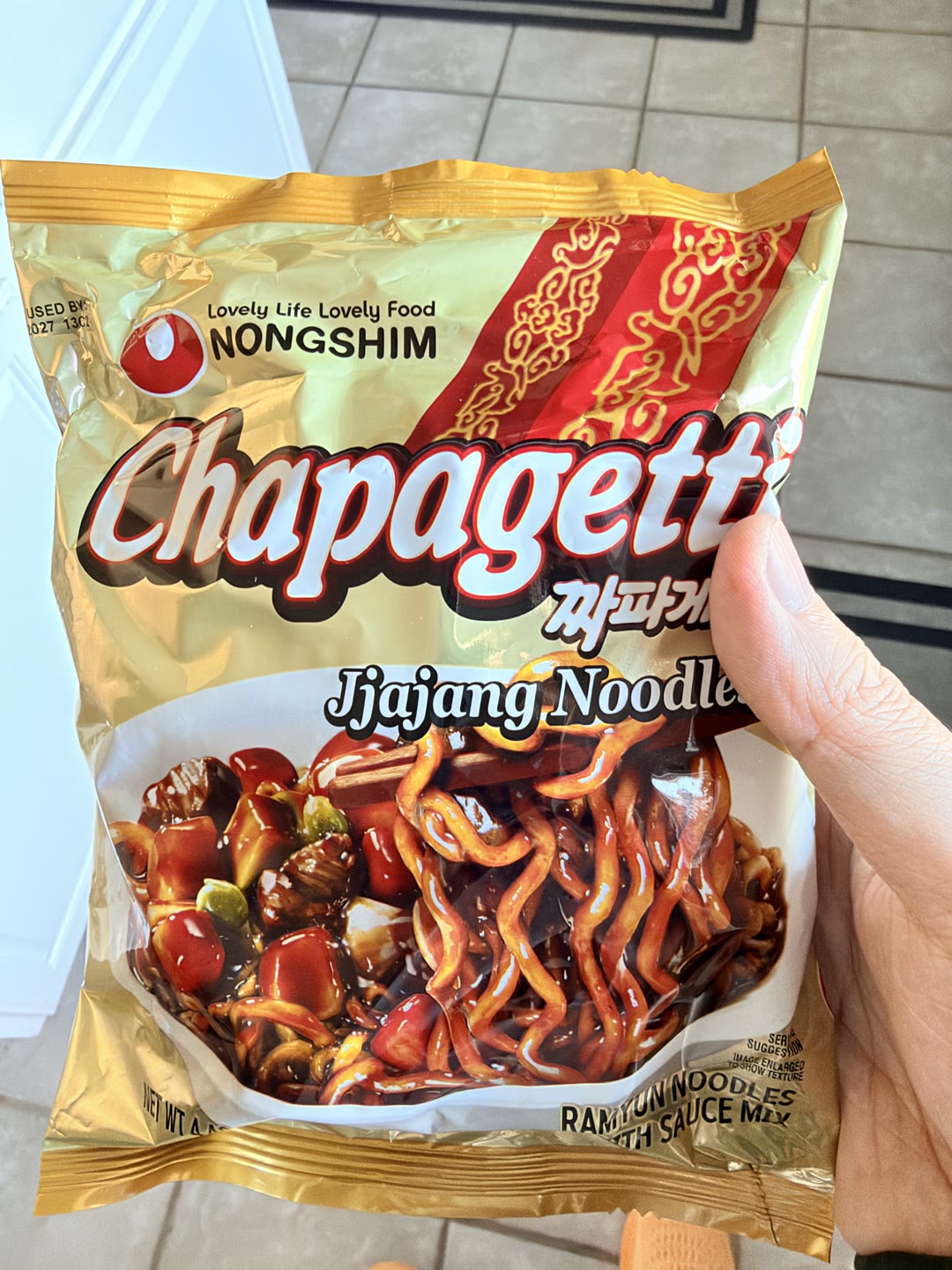 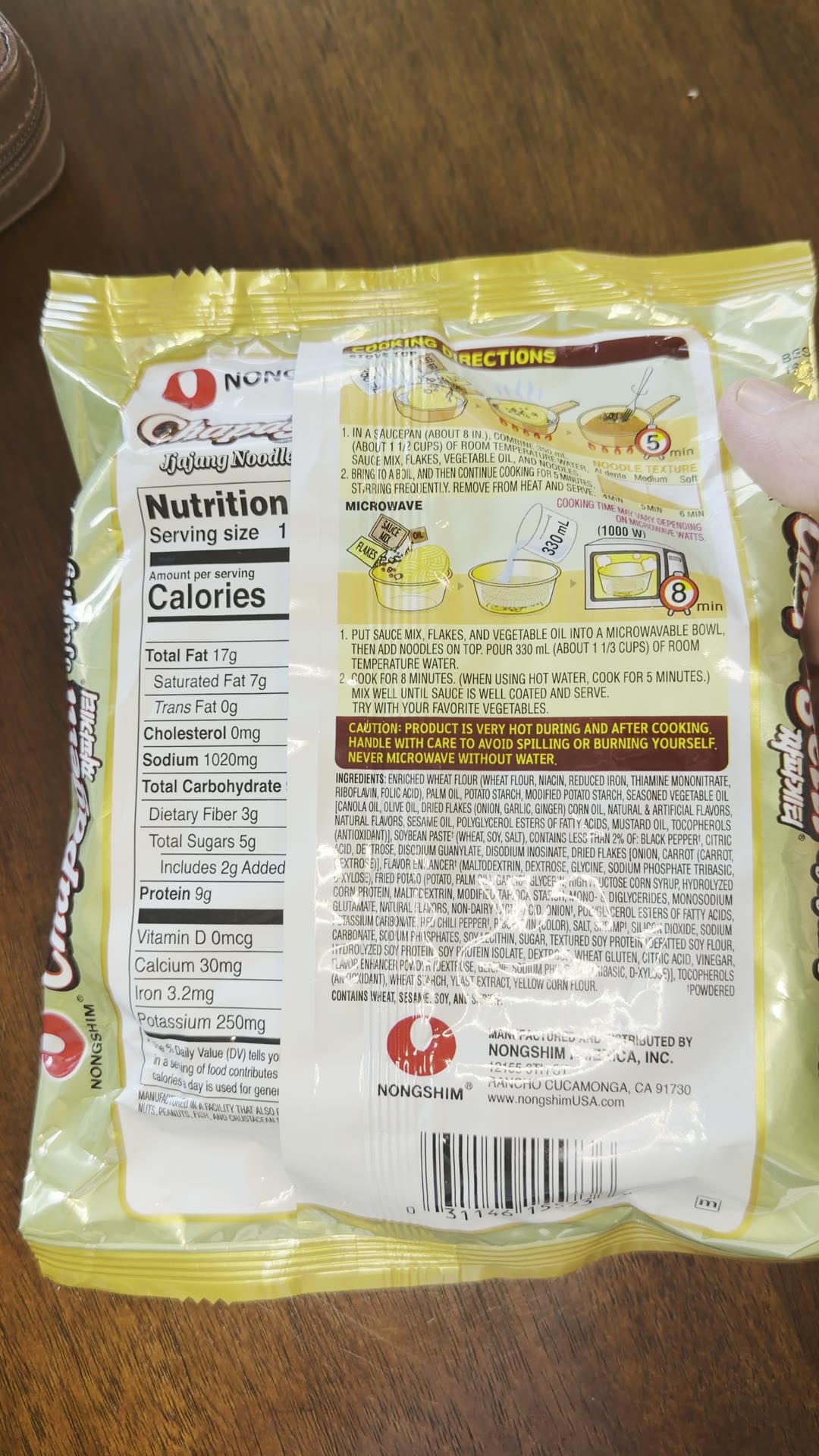 |
On the pack Stir / dry — the noodles boil on their own, get drained, then meet the sauce. Our way Battle station No. 9, cooked and eaten Nov 11, 2026 — the traditional one, and one corner of the battle's first duel. Nongshim Chapagetti (127 g), no heat at all. His method runs on a five-minute clock: noodles into boiling water for three minutes with one good loosen, heat off and lid on for a steam finish that does not count, the cucumber cut during the rest, two-thirds of the water poured off, the sauce mixed in for thirty seconds. Onto the bowl went three pieces of beef galbi grilled that morning — his words: a perfect match. Cucumber and raw garlic are requirements at his table, for this pack as for every jjajang. His verdict, in his own words: simple, fast, the traditional flavor — good, never showy, and it will never let you down. 8.0 out of 10, against the Ilpoom's 8.5 across the table; the half point, he says, is surprise. He buys it again: a pantry staple, gentle enough for kids and grandparents. Read the full step-by-step guide → | |||||||
| 29 | Bae Hong Dong | Nongshim | Stir / dry | Hot | — | Not yet read | Frontphoto to come Backphoto to come |
On the pack Stir / dry — the noodles boil on their own, get drained, then meet the sauce. Our way Not cooked yet — our way with this pack, and the tasting note, land here the day it meets our pot. | |||||||
| 30 | Bae Hong Dong XXX Spicy▶ Watch the episode — EP10 — New Method: Milk-Boiled Noodles, Sweeter & Softer 🍜 Triple X 8.2/10 — The Great Ramen Battle | Nongshim | Stir / dry | Fire | 440(Read off the U.S. back label of the pack in hand — Nutrition Facts, 1 bag (129 g): 440 kcal.) | Read off our own pack | 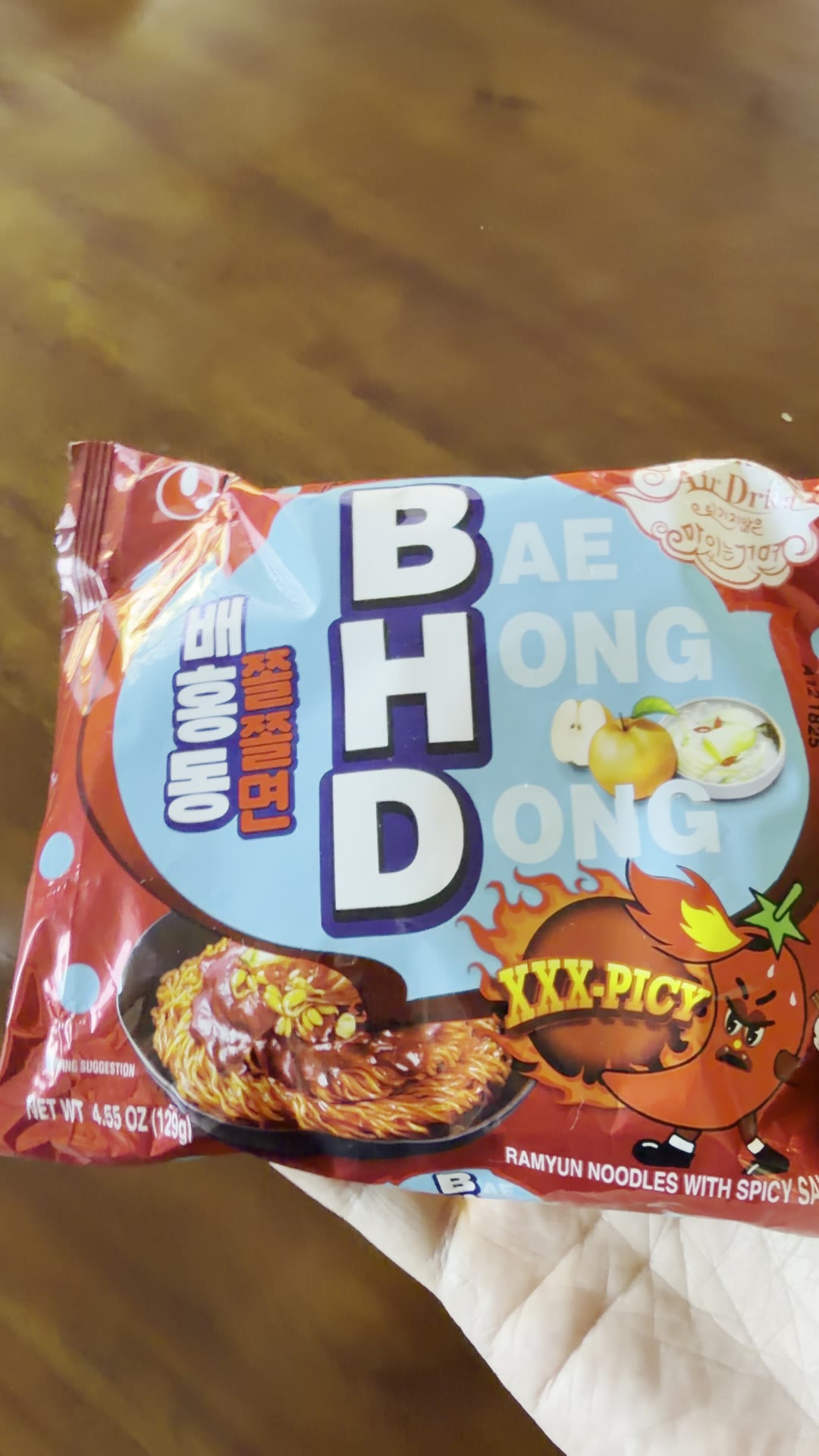 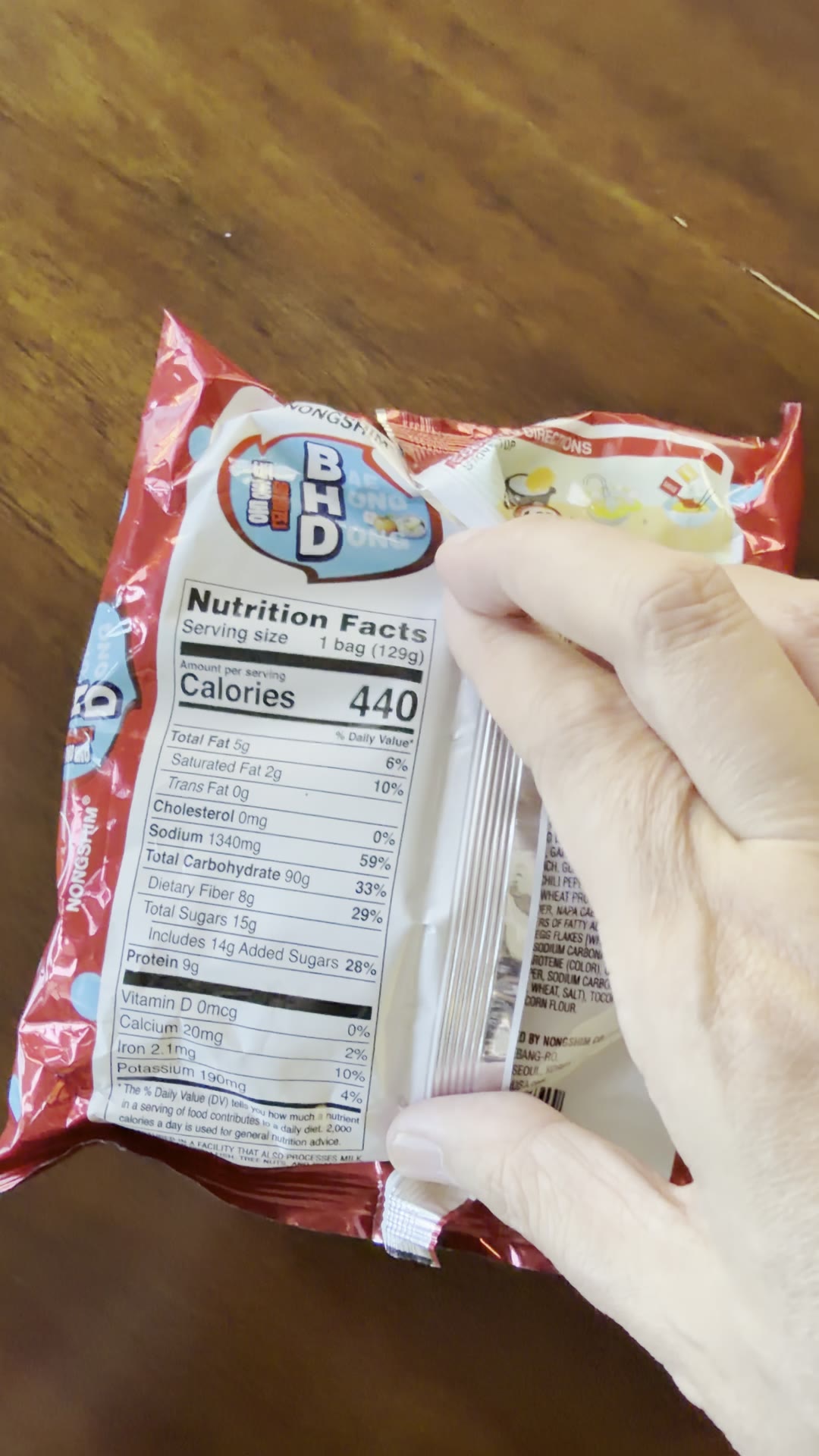 |
On the pack Stir / dry — the noodles boil on their own, get drained, then meet the sauce. Our way Battle station No. 10, cooked and eaten Nov 12, 2026 — the red one with the flaming tomato, and the bowl the milk method was invented for at our table. His way with it: not plain water — half a cup of milk and a bottle of mineral water; the heat off the second it boils, lid on, a steam rest; then one third of the sauce sachet, never the whole thing. The pot is the price: milk and water climb like they mean it — it boiled over twice the day he cooked it, and the rule now is you do not leave that stove. The reward: noodles sweeter and softer than any water boil gives, gentle enough for grandparents and kids. Cucumber sticks are law, cherry tomatoes are luck, half an iced Korean pear after the heat is heaven, and a bottle of water stands beside the bowl — even at one-third sauce, his first bite sent him straight to it. His verdict: 8.2 out of 10. The Buldak (station No. 8) still wins on chew; this one wins on sweet and soft. He might buy it again — but it is no pantry staple; it is too hot for that. An occasional thrill. Read the full step-by-step guide → | |||||||
| 31 | Spicy Kimchi Ramyun▶ Watch the episode — EP11 — Skip the Packet: Kimchi Does It All 🍜 Spicy Kimchi 8.3/10 — The Great Ramen Battle | Nongshim | Soup | To be classified | 500(Read off our own pack's label, on camera — U.S. version, 1 bag (120 g): 500 kcal for the whole bag.) | Read off our own pack | Frontphoto to come Backphoto to come |
On the pack Soup bowl — the seasoning goes straight into the pot with the noodles. Our way Battle station No. 11 — the never-fail bowl. His way with it: the noodle cake only; the soup packet never leaves the bag — no packet, no MSG at all. Kimchi stews first and does all the seasoning (he eats light salt, and the kimchi's own salt is enough); tofu and cherry tomatoes go in; just before the noodles are done, the heat goes off and the steam finishes them. Raw garlic on the finished bowl, always. His verdict: the cake itself is ordinary — the method never fails, and it would carry any cake. 8.3 out of 10, and he buys it again. Read the full step-by-step guide → | |||||||
| 32 | Paldo Ilpoom Jjajang▶ Watch the episode — EP7 — Paldo Ilpoom Jjajang × Cucumber & Raw Garlic 🍜 The Great Ramen Battle▶ Watch the full bowl — Ilpoom Jjajang, First Time — Cucumber Strips In, Raw Garlic Beside | The Great Ramen Battle EP7 | Paldo | Stir / dry | No heat | — | Not yet read | 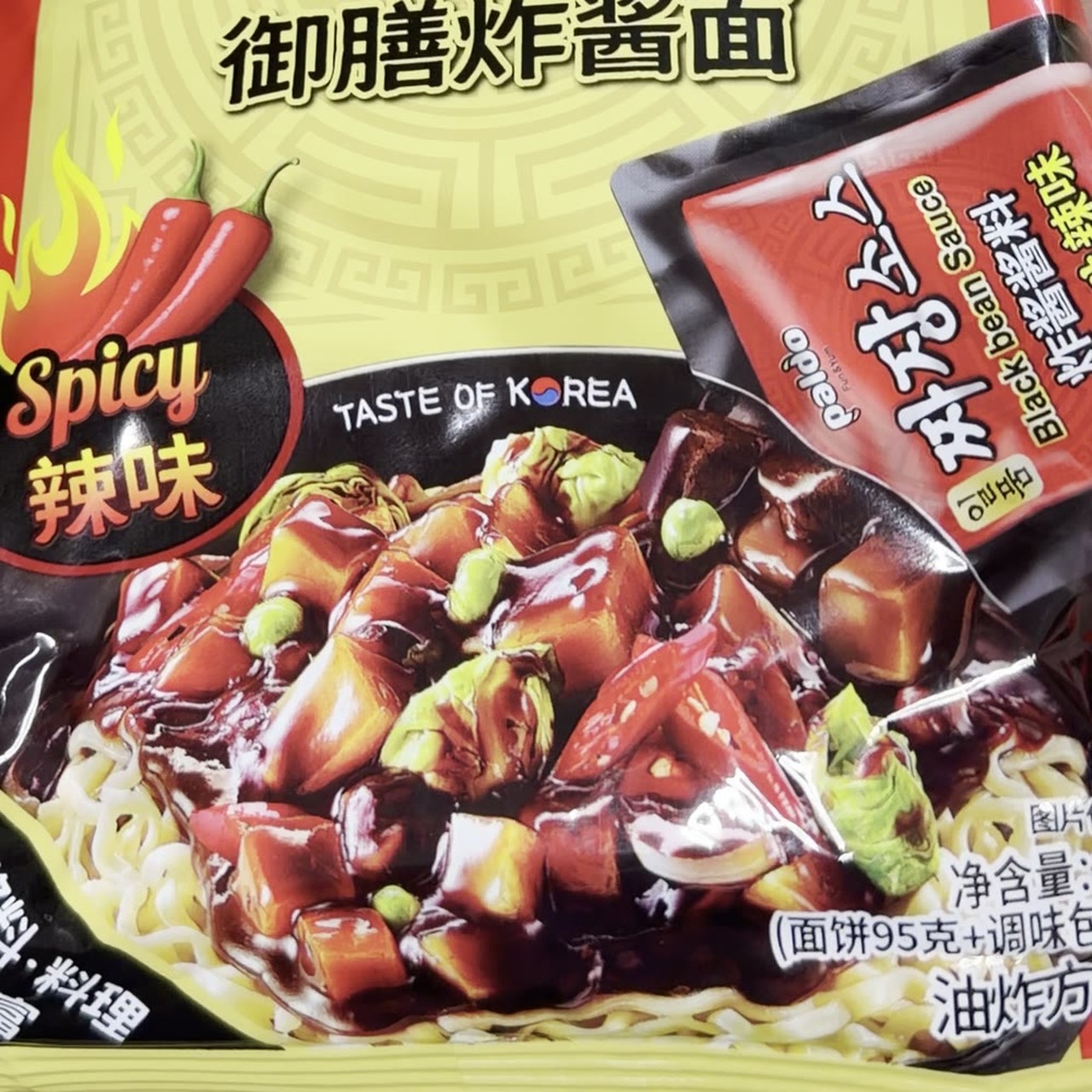 Backphoto to come |
On the pack Stir / dry — the noodles boil on their own, get drained, then meet the sauce. Our way Battle station No. 7, cooked and eaten Nov 9, 2026 — the cook's first time with this pack. The spicy export version (label name 御膳炸醬麵(辣味), 190 g). His simplest method: boil the cake, pour off most of the water, sauce in and mix; leftover tomato-egg from lunch folded in. His two rules for jjajang: cucumber strips get mixed in — the normal way, he says — and a raw garlic clove goes with every bowl (his saying: noodles without garlic lose half their fragrance). His verdict: great flavor, a little heat, different from his usual bowls — a pleasant surprise. His score: 8.5 out of 10, and he will buy this one again. Read the full step-by-step guide → | |||||||
| 33 | OK Ramyun | — | To be classified | To be classified | — | Not yet read | Frontphoto to come Backphoto to come |
On the pack To be classified Our way Not cooked yet — our way with this pack, and the tasting note, land here the day it meets our pot. | |||||||
| 34 | Ottogi Sesame Ramyun | Ottogi | Soup | No heat | — | Not yet read | Frontphoto to come Backphoto to come |
On the pack Soup bowl — the seasoning goes straight into the pot with the noodles. Our way Not cooked yet — our way with this pack, and the tasting note, land here the day it meets our pot. | |||||||
| 35 | Ottogi Plain Instant Noodle | Ottogi | To be classified | No heat | 470(Per the 110 g pack in hand on cooking day, back label read on camera: 470 kcal, sodium 620 mg, total fat 15 g (saturated 8 g), carbs 75 g, fiber 2 g, sugars 2 g, protein 10 g, cholesterol 0 mg. Brand record, two accounts side by side, to be confirmed: the cook names the plain block he buys as PLANET Ramen Noodles (70 g, halal mark, no seasoning packet); the pack the noodle came out of on cooking day reads Ottogi PLAIN INSTANT NOODLE (라면사리), 110 g, 'NO POWDER SOUP INCLUDED', Product of Korea. Every figure in this row is the Ottogi pack's; no PLANET figure has been read yet.) | Read off our own pack | 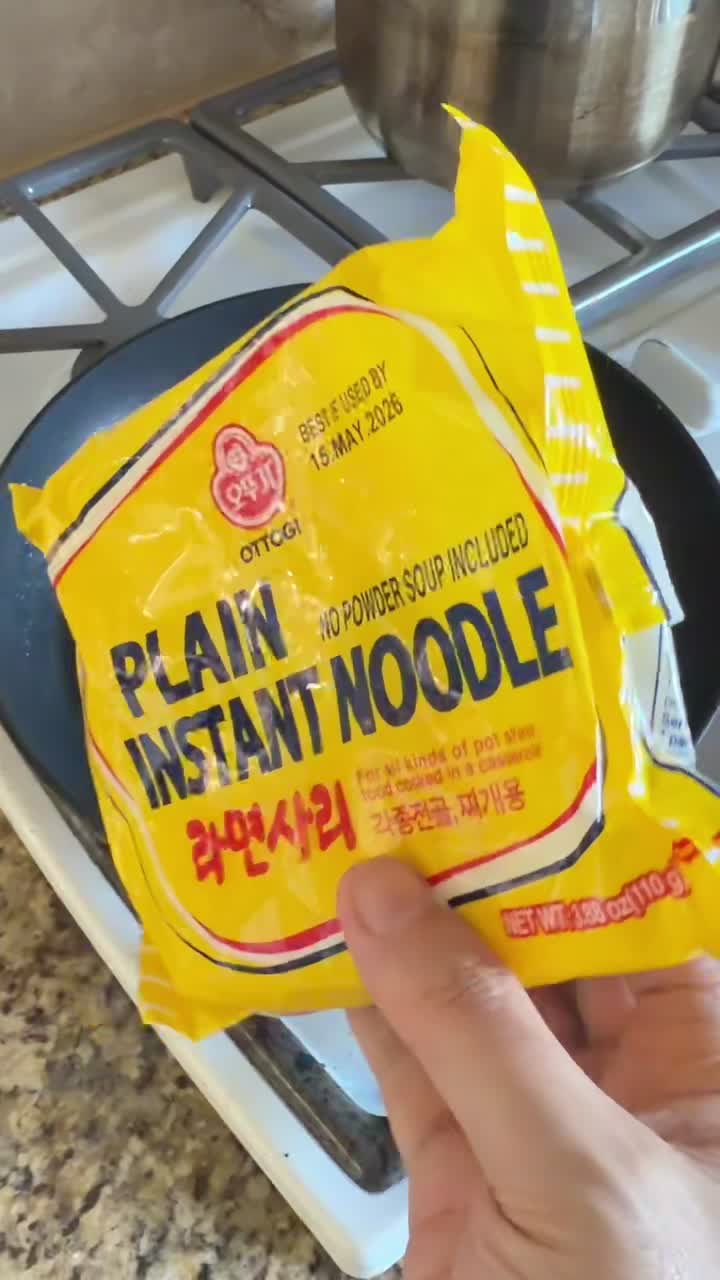 Backphoto to come |
On the pack To be classified Our way Cooked at our table on Nov 4, 2026 — station No. 3 of the Ramen Battle, and the inventor's own bowl. On the pack: there is no pack method — a plain noodle block with no powder soup included, the budae-jjigae staple Korean kitchens keep stocked; the pack gives the noodle and nothing else. Our way: the block into boiling water, heat off at once, soaked to half-done while the pan work happens; eggs fried first and set aside; kimchi chopped as fine as it will go — the finer, the better — fried with tomato and onion for about half a minute to a minute, until its aroma fully opens; two to four spoonfuls of the noodle water; the half-done noodles in and tossed until the juices fry dry; the eggs back in along the way. Eaten with two cloves of raw garlic and a bottle of beer. The verdict, in the cook's own words: the soul of this bowl is fragrant, not fiery — the kimchi fried until its aroma completely blooms. He jokes it could carry a patent. Read the full step-by-step guide → | |||||||
| 36 | Samyang Ramen, Original | Samyang | Soup | Gentle | — | Not yet read | Frontphoto to come Backphoto to come |
On the pack Soup bowl — the seasoning goes straight into the pot with the noodles. Our way Not cooked yet — our way with this pack, and the tasting note, land here the day it meets our pot. | |||||||
| 37 | Ramyun Chef Curry Chicken | Nongshim | Soup | Gentle | — | Not yet read | Frontphoto to come Backphoto to come |
On the pack Soup bowl — the seasoning goes straight into the pot with the noodles. Our way Not cooked yet — our way with this pack, and the tasting note, land here the day it meets our pot. | |||||||
| 38 | Buldak Original▶ Watch the episode — EP8 — Buldak Original × Half a Sachet Was Too Much 🔥 The Great Ramen Battle | Samyang | Stir / dry | Fire | 560(One bag (140 g) is the whole serving: 560 kcal, sodium 1,630 mg — read off our pack's back label on camera, Nov 10, 2026.) | Read off our own pack | 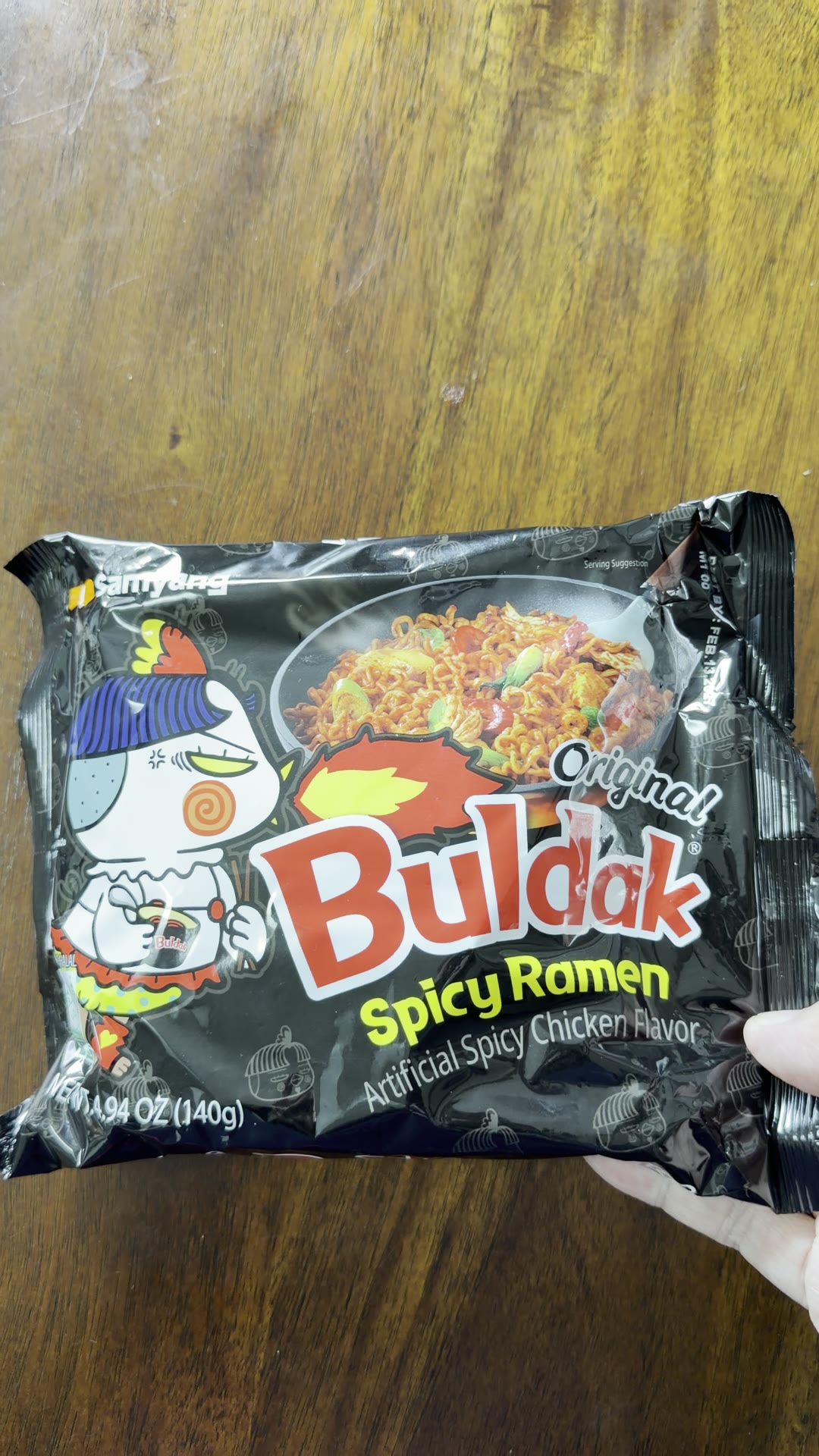 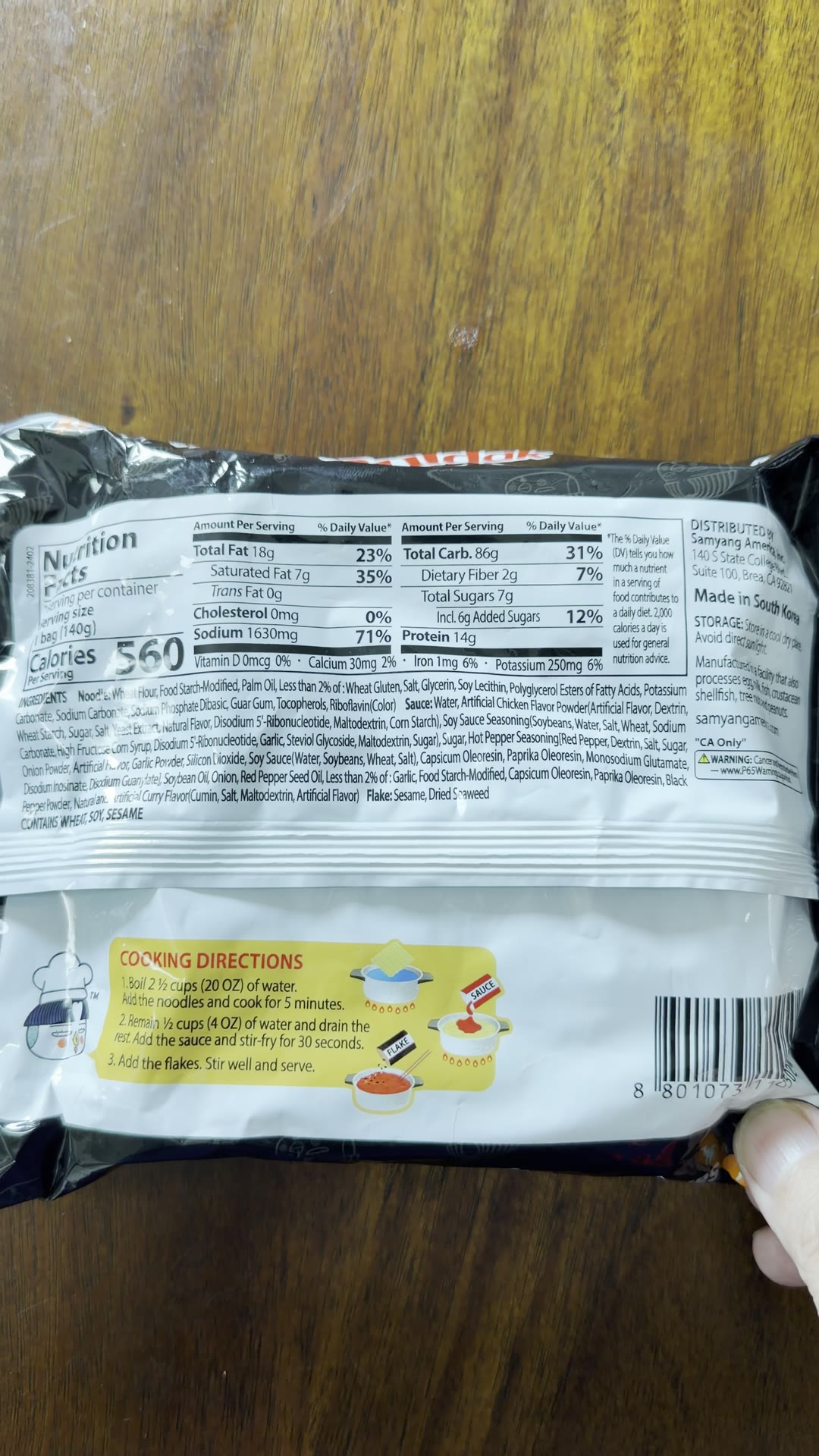 |
On the pack Stir / dry — the noodles boil on their own, get drained, then meet the sauce.5 min · per the pack's own directions, read off our pack Our way Battle station No. 8, cooked and eaten Nov 10, 2026 — the black pack at last. Samyang Buldak Original (US label: Spicy Ramen, Artificial Spicy Chicken Flavor, 140 g). His method: noodles into water already boiling, heat off near the end, lid on to finish — that is where his chew comes from. Leftover roast chicken torn in, the morning's leftover salad under it. And the rule this station leaves behind: half the sauce sachet, never more, your first time. He handles spicy food well and half a sachet still beat him — he did not finish the bowl; sparkling water and an orange closed the meal. His words: of all the spicy noodles he has eaten, this is the spiciest. The chew matched the springiest noodle he knows; the sauce carries salt and sweet under the fire. He wanted to give it 9 and docked it only because the heat beat him: 8.7 out of 10 — judged across the dozens of noodles he has eaten — and he buys it again, without regret. In his words: one word, thrilling; two words, spicy; three words, spicy and thrilling. Read the full step-by-step guide → | |||||||
| 39 | Buldak Swicy | Samyang | Stir / dry | Gentle | — | Not yet read | Frontphoto to come Backphoto to come |
On the pack Stir / dry — the noodles boil on their own, get drained, then meet the sauce. Our way Not cooked yet — our way with this pack, and the tasting note, land here the day it meets our pot. | |||||||
| 40 | MAMA Oriental Kitchen | MAMA | To be classified | Hot | — | Not yet read | Frontphoto to come Backphoto to come |
On the pack To be classified Our way Not cooked yet — our way with this pack, and the tasting note, land here the day it meets our pot. | |||||||
| 41 | Paik Ramyun | Paik Cook | Soup | To be classified | — | Not yet read | Frontphoto to come Backphoto to come |
On the pack Soup bowl — the seasoning goes straight into the pot with the noodles. Our way Not cooked yet — our way with this pack, and the tasting note, land here the day it meets our pot. | |||||||
| 42 | Ottogi Maneung (garlic) | Ottogi | To be classified | To be classified | — | Not yet read | Frontphoto to come Backphoto to come |
On the pack To be classified Our way Not cooked yet — our way with this pack, and the tasting note, land here the day it meets our pot. | |||||||
Badges say where a number came from: read off the physical pack we own, or — once admitted under the version-matching rule — an official figure double-checked against a second source. An empty calorie cell means the label has not been readable yet, not that the number is zero.
How we cook them — one house method for every pack
Every pack in the roster gets cooked at our table the same honest way, and the steps that follow are written exactly as we do them — a reference, not a rulebook, because firmness is personal and no two stoves are quite alike.
Water first: the pot comes to a proper rolling boil before any noodle goes in — never into cold water. Then the form decides the rest. A soup pack's seasoning goes straight into the pot with the noodles; a stir pack's noodles boil on their own, come out and get drained, and only then meet the sauce. If there are greens in the fridge, a handful goes in — ramen takes kindly to company. And two minutes before the heat goes off, an egg goes in: cracked straight into the soup, to poach in the very bowl it will be eaten from.
One preference, stated plainly: my own stomach is not the strongest, and I like my noodles soft — so our pot usually runs a little past the minutes printed on the pack. Like yours with bite? Stop earlier. The minutes shown in each row of the table are the pack's own, read off its directions the same way we read its calories; a row without minutes belongs to a pack whose directions we have not read clearly yet, and the figure joins the day that pack is opened and photographed — never before, and never by guessing.
The seasoning packet, finally, is a dial and not a duty: if your taste runs light, half the packet is honestly enough — and on the fire-tier packs, that half is also the line between dinner and a dare. Each pack's row in the table carries the same honesty in miniature: what the pack says first, and — once the battle has cooked it for real — our way with it and the tasting note from the day. Until that day, the space stays empty on purpose. We do not write up a bowl we have not eaten.
How our numbers work — read, matched, or not printed
Three states, and only three. “Read off our own pack” means we turned the physical pack over and read the back label ourselves; the figure on this page is the number on that label, converted to a whole-pack total, and where a label counts servings the maths is printed beside the figure — Champong's 560 is its label's 280 × 2. “Official, double-checked” is the second road in, and it is open: a figure the maker publishes, confirmed against a second source, and admitted only when it matches the exact version sitting on our table — the note beside each such figure states which version and weight it belongs to. “Not yet read” means the name is on the roster and the number is not — no estimates, no borrowed figures, no exceptions.
Version-matching is the rule that guards the door, because the same name can hide different packs. Our two Buldak Cheese packs — the orange export pack and the red “Last Flame” pack — read 590 and 510; neither number may stand in for the other, and a figure for a version we do not own never enters this table. One pack among the first ten even carries two disagreeing labels, a main panel at 470 and a sticker at 462; we follow the pack's main nutrition panel and keep the disagreement on record rather than quietly picking the friendlier number.
The roster grows the honest way: a pack joins the ranked rows on the day its number is verified — its own label photographed flat, straight and readable, or the maker's figure matched to the exact version on our table. Its front and back photos land in its row the day the pack is opened and photographed flat. Until then it waits, named and numberless. And if you spot a pack we have wrong, tell us in the comments of the battle videos: corrections get read off the pack, not argued about.
The scoreboard questions — quick answers
Which Korean ramen has the most calories? Of the packs counted so far, Neoguri Stir-Fry Seafood (Nongshim) leads at 620 kcal per pack, read off our own pack's label. The crown is provisional — every other pack joins the ranking the day its number is verified: its own label read clearly, or an official figure matched to the exact version on our table.
Which Korean ramen is the spiciest? The fire corner of our table is Samyang's Buldak family: the original is already properly hot, a wide margin above Shin Ramyun, and the 2X — Samyang's doubled version — sits at the top of that ladder, while the Carbonara is the family's gentlest door in. We grade heat in tiers from the packs themselves; we do not print SHU figures we have not verified.
How many calories are in Shin Ramyun? Two tracks, kept separate. Off our own pack, we still don't know: the label is creased over one digit of its per-serving figure, and a number we cannot read in full does not go on this page as a pack reading. Off the official label, the U.S. version of Shin Ramyun is 520 kcal per pack (260 × 2 servings) — double-checked against a second source, and the version sitting on our table — so the table carries 520 with an “official, double-checked” badge. The Korean-market label for the same name reads 500; that figure belongs to a different version and is never borrowed for ours.
Where do the calorie numbers on this page come from? Figures arrive by two roads, and the badge beside each one says which. “Read off our own pack” is the back label of the physical pack we own, converted to a whole-pack total with the maths shown beside it. “Official, double-checked” is a maker-published figure, confirmed against a second source and admitted only when it matches the exact version on our table; the note beside the figure states which version and weight it belongs to. A figure for a different version never enters the table.
One last thing — you pick the next mash-up
Korea has a proud tradition of cooking two ramens in one pot — Chapagetti and Neoguri even have a famous child the whole world has met: the 'Chapaguri' from the film Parasite. So tell us in the comments: which two — or three — Korean ramens should we cook together next? Shin meets Buldak? Jin meets Bibim Men? We will take the most-loved idea to our own stove, film it, and add it to our noodle series. Thank you for reading at our table — pull up a chair; the kettle is already on.
More recipes
- Mom's Love Bento #1 — Sausage, Little Fried Fish, Cake & Melon
- Mom's Love Bento #2 — Fried Chicken, Tofu, Salad & Biscuits
- Mom's Love Bento #3 — Fried Chicken, Sardines, Salad & Cantaloupe
- Mom's Vegetarian Kimchi Sundubu — Meat-Free Korean Soft Tofu Stew
- One Pot, Three Rounds: Our Spicy Seafood Pot
- Korean Barbecue — Straight Off The Grill
- Honey Pig — The Table Behind Our Korean BBQ Series
- His First Steak — Dad's Method, Step by Step
- Butter Lobster Tails At Home — Just Like A Steakhouse
- Popeyes Fried Chicken Nights
- Homemade Noodles — Our Family Noodle Series
- Sushi, Happy Life — A Family Friday
- Korean BBQ Night — At Home
- Top Ten Easy Korean Home Dishes — Collected at Our Own Stove
- Soba Salad — Cold Soba with Cucumber, Egg and One Non-Negotiable Lemon
- Homemade Salads — Our Family's Numbered Salad Series
- Beef Pho at Home — The Bone Bigger Than the Bowl
- How I Made My Simple Lunch at Home
- My Simple Breakfast
- One Minute Breakfast
Cooking ideas, not nutrition or medical advice. Check allergens and cook meat and eggs to safe temperatures.